Biggest Largemouth Bass Ever Caught: Records Explained
A careful guide to the biggest largemouth bass ever caught, why famous record claims can be complicated, and how official records are documented. Learn what makes a weight credible and how to handle a potential record fish responsibly.
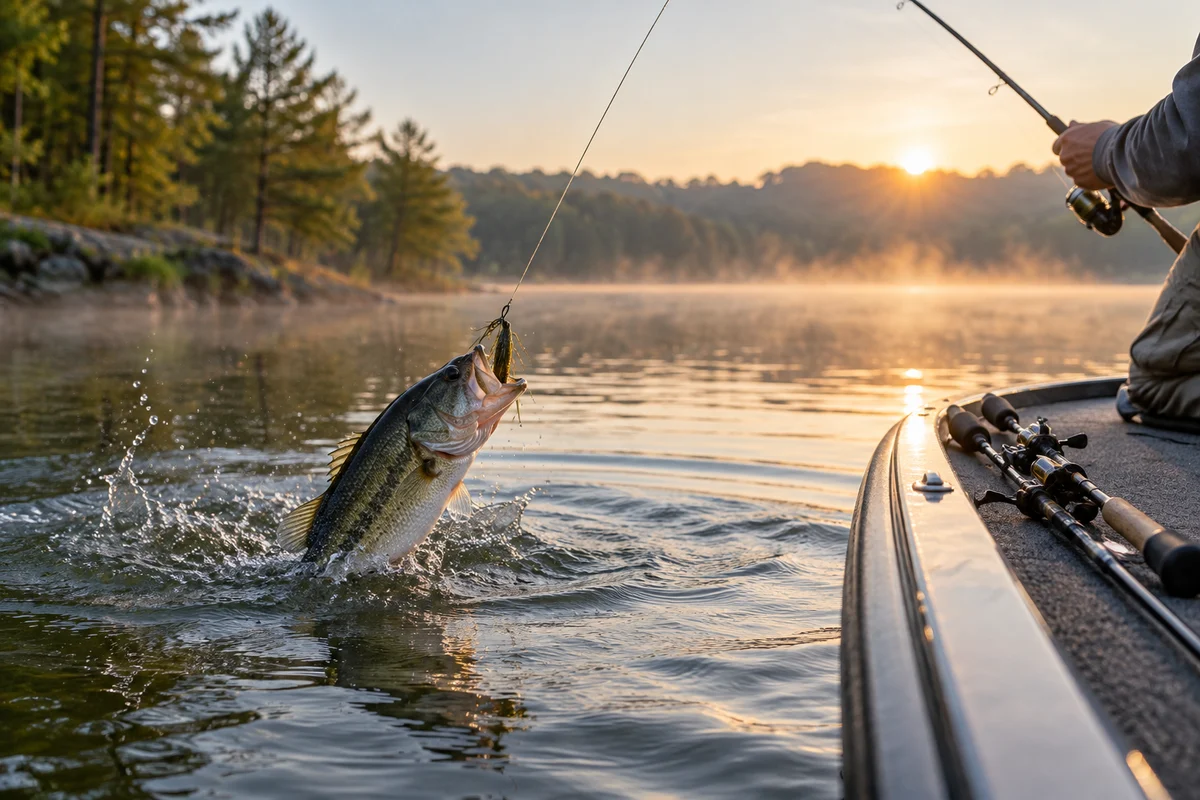
The phrase biggest largemouth bass ever caught sounds like it should lead to one simple number and one unquestioned fish. In practice, record claims depend on the record category, the evidence submitted, and the rules in force when the fish was landed. The widely recognized all-tackle benchmark is shared by a largemouth caught in Georgia in 1932 and a fish caught in Japan in 2009; both are listed at 22 pounds, 4 ounces by the International Game Fish Association (IGFA). That does not make every online “top 25” list a verified ranking. It makes the recordkeeping details essential.
This guide explains how to read the headline, distinguish recognized records from memorable local catches, and prepare sensibly if you encounter an unusually large bass. For broader seasonal and habitat advice, see the bass fishing hub.
What is the biggest largemouth bass ever caught?
The best-supported short answer is that the recognized all-tackle world record is a tie at 22 pounds, 4 ounces. George Perry’s Georgia fish, caught at Montgomery Lake in 1932, became the long-standing benchmark. In 2009, Manabu Kurita landed a largemouth in Japan that was accepted by the IGFA at the same weight. The two catches are commonly described as a tie rather than ranked first and second.
“Biggest” can also mean something narrower: a state record, a lake record, a tournament weigh-in, a junior or line-class record, or the heaviest fish reported in a news story. Those categories are not interchangeable. A fish may be genuinely large and locally documented without qualifying for an international record category. Conversely, a recognized record’s status reflects formal review, not merely the number repeated in a headline.
The IGFA is the organization to consult for its current world-record listings and requirements. Records can change, and categories or documentation rules matter. Check the official listing rather than relying on a repost, a social-media caption, or a list that does not identify its source.
Why do record lists disagree?
A long “top 25” ranking is particularly easy to misread. Many lists mix verified records with historical reports, tournament catches, state records, and claims for which the original measurement or paperwork is difficult to confirm. They may also use different standards for species identification, scale accuracy, or whether a fish was eligible for a particular category.
| Claim or record type | What it can tell you | What to verify |
|---|---|---|
| IGFA world record | A catch accepted under a defined international record category | Current listing, category, date, and documentation standard |
| State record | The largest fish accepted under that state’s rules | State agency’s current list and the applicable category |
| Tournament weigh-in | A fish’s weight as recorded at a specific event | Event rules, scale procedure, and whether it was an individual or total weight |
| Lake or club record | A local milestone under local rules | Who maintains the record and how the fish was measured |
| Historical or media claim | A reported catch worth investigating | Original source, contemporaneous evidence, and independent verification |
Older catches can be hard to compare with modern ones. Records may have been kept in different units, scales may have had different calibration practices, and surviving paperwork may be incomplete. A figure’s repetition over time is not itself proof. That caution does not erase historical accomplishments; it helps readers understand what the evidence can and cannot establish.
How does a largemouth record get verified?
The exact process depends on the recordkeeper and category. Common requirements include a clear species identification, an accurate weight from an acceptable scale, witness information, photographs, and a completed application submitted within required deadlines. Line-class or tackle categories may require additional information about the equipment and line. Never assume that one organization’s rules automatically apply to a state agency or tournament.
If a fish could be a record, slow down before releasing it or transporting it. First follow local regulations and prioritize the fish’s welfare. Ask a qualified witness to help document the catch, note the location and time, photograph the fish alongside a measuring reference, and preserve the scale’s identifying information. If weighing is contemplated, use a suitable, properly checked scale and follow the recordkeeper’s instructions. Do not delay a safe release merely to create a record attempt.
A photograph alone usually cannot establish an official weight. Perspective, camera angle, and an unknown scale can make a fish appear larger or smaller than it is. A tape measurement is useful supporting information, but length is not a substitute for an accepted weight when the category requires one.
What should you do if you catch an unusually large bass?
Use this field decision framework:
- Protect the fish first. Keep it in the water when practical, minimize handling, wet your hands, and avoid squeezing the body or touching the gills. Keep the fish supported horizontally rather than letting its full weight hang from its jaw.
- Check the rules. Review the relevant state fishing regulations and the specific record category. Seasons, size limits, possession rules, and documentation requirements vary by place.
- Document without guessing. Record the date, waterbody, approximate location, witnesses, length, and weight only as measured. Photograph both sides and any scale display clearly, without staging an unsupported claim.
- Contact the recordkeeper promptly. Ask what evidence and deadlines apply before relying on a homemade procedure. A state record and an IGFA record may require different applications.
- Make a responsible release or retention decision. Follow local law and the fish’s condition. Do not keep a fish solely because a possible record is exciting; record eligibility and fish welfare are separate questions.
These steps are general, not a substitute for official instructions. The IGFA maintains international record information, while state wildlife agencies publish local regulations and state-record procedures. Verify the current rules where you fish.
Do giant bass tell anglers how to catch one?
A record catch is not a dependable recipe. Large bass may use different parts of a lake or river as temperature, forage, water level, and season change. A single fish’s capture does not prove that a particular lure, location, or technique will consistently produce giants. Anglers can make more useful decisions by reading conditions and matching presentations to cover and forage.
For example, a surface lure can be one option when bass are feeding near the top or around suitable shallow cover; the floating buzz bait guide explains the basic context for that presentation. In cooler early-season conditions, a slower or more controlled search may make more sense; see choosing lipless crankbaits for early-season bass. Neither approach guarantees a large fish. Water clarity, depth, vegetation, weather, local forage, and fishing pressure all affect what is practical.
Treat record stories as inspiration, not as promises. A giant bass is an individual fish from a particular place and moment. Its record significance comes from credible documentation and an accepted category; its value to the fishery also depends on responsible handling and respect for local rules.
How to evaluate a “top 25” bass list
Before sharing a ranking, ask three questions: Does each entry identify a recordkeeper? Does it distinguish world, state, tournament, and unverified claims? Does it provide enough context to locate the original record or evidence? If not, read it as a collection of reported large catches, not an authoritative ranking.
For current status, use the relevant official record list. For an old claim, look for contemporaneous reporting or archival documentation and note any uncertainty plainly. Do not fill gaps with invented weights or assume that a fish’s estimated size equals a certified measurement. This approach keeps the story interesting while respecting the anglers, recordkeepers, and fish involved.
The biggest largemouth bass ever caught remains a compelling question precisely because “biggest” requires a standard. The recognized 22-pound, 4-ounce tie is a clear answer within the IGFA all-tackle context. Beyond that, categories and evidence determine what can responsibly be called a record.
Frequently asked questions
What is the recognized world-record largemouth bass weight?
The IGFA all-tackle record is listed as a tie at 22 pounds, 4 ounces, for a Georgia catch from 1932 and a Japan catch from 2009. Check the IGFA’s current listing for status and category details.
Are all fish on online lists of the biggest bass officially verified?
No. Lists may mix recognized world records, state records, tournament catches, and historical or unverified reports. Look for the named recordkeeper and its documentation.
What should I do if I think I caught a record largemouth bass?
Prioritize fish welfare and local law, document the catch accurately, and contact the relevant recordkeeper promptly for category-specific procedures. Do not assume photographs or a tape measurement alone establish an official record.
Sources & further information
Consult these primary sources for current regulations, technical information and local guidance.