Shallow bass castable umbrella rigs: Shallow Bass on Castable Umbrella Rigs: A Practical Guide
Castable umbrella rigs can imitate a small group of baitfish in shallow water, but their wire arms demand careful attention to depth, cover and local rules. Use this practical framework to choose a rig, make controlled presentations and know when to simplify.
This guide to shallow bass castable umbrella rigs separates useful field knowledge from claims that need authoritative verification.
Castable umbrella rigs can make sense when bass are feeding on compact groups of baitfish in shallow water. These multi-arm lures spread several small swimbaits around a central frame, creating a broad moving silhouette; they are not a universal answer for shallow fish. The useful question is whether the rig can pass through the available water and cover without snagging, fouling or violating local rules. A little planning helps you decide where it belongs in the rotation—and when a single lure is more practical.
What makes a castable umbrella rig useful in shallow water?
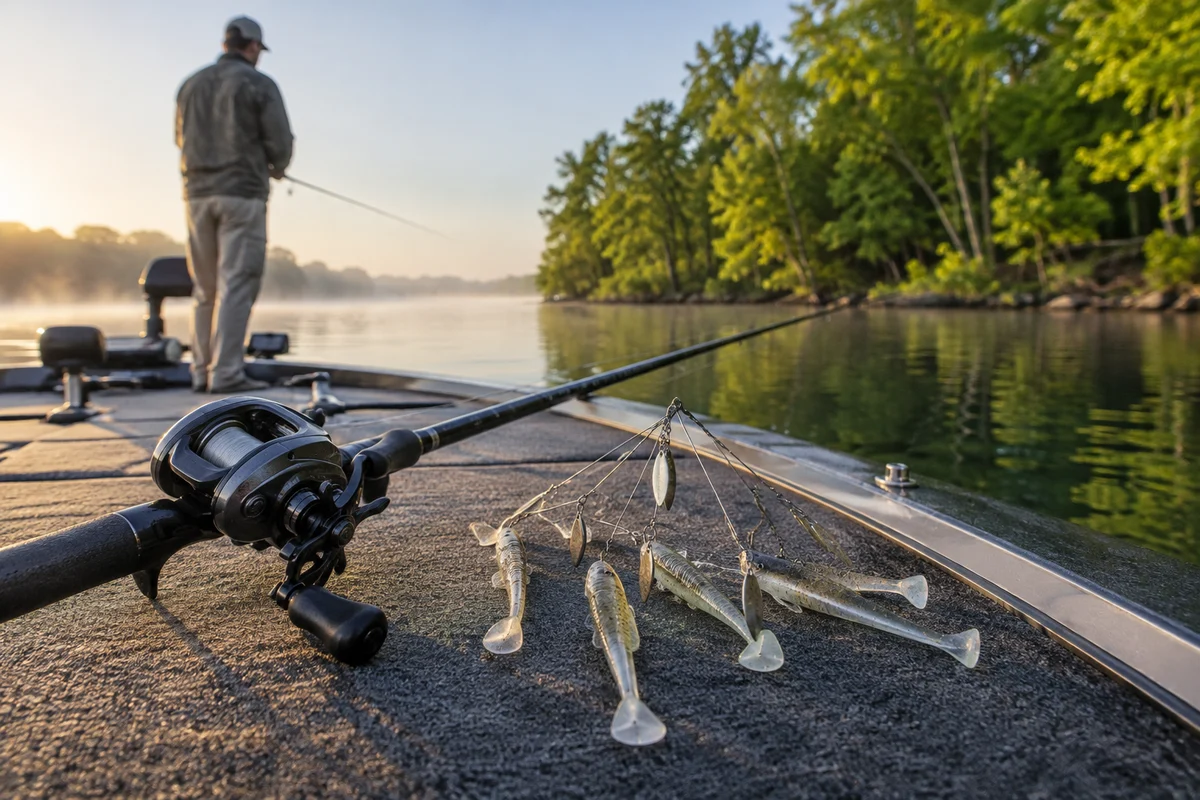
An umbrella rig presents multiple bait-like targets on one cast. In clear or moderately stained water, that cluster may resemble a small group of baitfish, while the moving blades or bodies create flash and vibration. Bass may respond when they are actively tracking forage, particularly along a shallow edge, over a clean flat, or beside a drop where bait is moving.
The rig’s footprint is also its limitation. Several arms and hooks occupy more space than a single swimbait, so weeds, brush, dock cables and crowded shorelines raise the chance of fouling. Its weight and resistance can make accurate casts harder, and multiple exposed hooks require extra care around people, pets and the boat. Treat it as a situational search bait, not a lure to force through every piece of cover.
For a more compact approach to active fish, compare the rig’s broad profile with the options in our guide to choosing a spinnerbait for bass. When fish are holding tight to a shallow bottom rather than chasing, a large worm presentation may be easier to place precisely.
Where should you look for shallow bass?
Start by identifying a route the rig can travel cleanly. Good candidates include the open side of a weed edge, a firm-bottom flat, the outside of scattered grass, or a lane beside a point. The best target is not necessarily the shallowest water; it is a depth band where the lure can move steadily without dragging bottom or clipping vegetation.
Look for signs that baitfish are present: flickers near the surface, small disturbances, or bass activity along a defined edge. These clues are not proof that fish will bite, but they help distinguish a likely feeding lane from empty water. Wind can push bait toward a bank or point, yet also make boat position and line control more difficult. If you cannot keep the lure on a predictable path, reposition before making repeated casts.
Water clarity matters as well. In clearer conditions, fish may follow a rig from a distance, so a controlled, natural-speed retrieve and a longer cast can keep the boat from crowding the target. In stained water, visible flash or vibration may help the lure register, but there is no color or action that guarantees a response. Match the rig’s overall silhouette to the forage you observe rather than adding components without a reason.
How do you choose a rig and make a controlled presentation?
Before tying on, check the frame, attachment points, swivels, hooks and soft baits for damage or fouling. Confirm that the assembled rig is within the rod, reel and line’s intended casting range. Manufacturers’ specifications and the product manual are the right references for a particular model; designs and legal configurations vary. A rod that feels overloaded, a loose connection or a bait that spins off-center is a reason to stop and correct the setup before casting.
A simple field decision framework keeps the choice practical:
| What you observe | Rig decision | First presentation |
|---|---|---|
| Open lane with baitfish activity | Try the rig if local rules allow its hook configuration | Cast beyond the activity and retrieve steadily through it |
| Scattered grass or isolated stems | Use only if the frame clears the vegetation | Keep the lure above the tops; stop if it begins collecting weeds |
| Thick weeds, brush or tight dock structure | Choose a more compact lure | Make accurate casts to openings and edges |
| Fish follow but do not commit | Change speed or angle once, then simplify | Try a single swimbait or spinnerbait rather than adding more hardware |
| No visible bait or fish response | Do not keep covering the same water by habit | Move to another depth, edge or forage sign |
Make a smooth cast with room around you. The rig’s arms and hooks can swing unpredictably, so check behind and beside you, keep other anglers clear, and avoid casting over people or pets. Let the lure reach the intended running depth, then retrieve at a steady speed. If it is too close to the surface, slow slightly or allow a controlled sink before starting. If it ticks bottom or gathers grass, speed up, raise the rod modestly, or move to a cleaner lane.
A few deliberate casts at different angles can reveal whether the fish are using an edge or crossing the flat. Change one variable at a time—casting angle, running depth or retrieve pace—so the result tells you something. Repeatedly speeding up, stopping and changing components all at once makes it difficult to identify what helped.
What tackle and handling considerations matter?
Use tackle rated for the assembled lure’s weight and resistance. A balanced outfit should let you cast without forcing the motion and maintain control during the retrieve. Check the maker’s guidance for line and rod compatibility; avoid assuming that every umbrella rig weighs the same. Keep hooks covered or secured while moving the lure between spots, and store it where its arms cannot snag clothing, upholstery or another angler’s line.
Multiple hooks make landing and unhooking more complicated. Keep pliers accessible, maintain a clear working area, and avoid grabbing the frame or reaching blindly near the fish’s mouth. If fishing with a partner, agree who is handling the fish before it reaches the boat. A landing net with suitable mesh can help control a fish, but the net should not be used to conceal or excuse careless handling. Follow local guidance on handling and release, and minimize the time a fish spends out of water.
Rules can differ by state, waterbody and season. They may limit the number of hooks, lures, or points that can be used, even if a product is sold as a multi-arm rig. Check the current regulations for the exact place you plan to fish, including any special waters or tournament rules. The [U.S. Fish and Wildlife Service] (https://www.fws.gov/) provides federal fish and wildlife information, while state fish and wildlife agencies publish the rules that govern most inland fishing. Do not assume a configuration is legal simply because it is common elsewhere.
When is a different lure the better call?
Choose a single swimbait when cover is tight, fish are wary, or the multi-arm frame keeps fouling. A spinnerbait can be easier to steer through scattered vegetation and offers a different profile; our spinnerbait selection guide explains how to think through that choice. If bass are tracking a baitfish imitation without striking, a subtle change in size, depth or approach may be more useful than adding more arms.
A floating buzz bait is a contrasting option when fish are willing to strike on the surface and the water is open enough for its retrieve. It is not interchangeable with an umbrella rig: the buzz bait creates a surface disturbance, while the rig is generally worked below the surface. See our overview of floating buzz baits for the conditions that favor that style.
Most important, let what the water shows guide the decision. If the rig repeatedly catches weeds, cannot be cast safely, or draws no response while another presentation reaches the target cleanly, switch. A lure is useful when it helps you cover the right water with control—not merely because it carries more components.
A short pre-cast checklist
- Confirm the rig is intact and compatible with your tackle.
- Check the local rules for hook and lure limits on that water.
- Look behind you and keep people clear of the casting arc.
- Choose an open lane and a running depth that avoids bottom and weeds.
- Start with a steady retrieve; adjust one variable at a time.
- Secure the hooks before moving or storing the rig.
Castable umbrella rigs can be a focused tool for shallow bass when baitfish, open lanes and a controlled retrieve line up. Their size and hook count call for more planning than a single lure, and they are a poor fit for dense cover or uncertain regulations. Make the first decision from the conditions, keep each cast deliberate, and switch to a simpler presentation when it offers better control.
For more related outdoor reading, explore our bass fishing fishing freshwater hub.
Frequently asked questions
Can you fish a castable umbrella rig in shallow water?
Yes, when there is a clean lane and enough depth to retrieve it without dragging bottom or collecting weeds. Check local rules and use tackle rated for the assembled rig.
How should I retrieve an umbrella rig for shallow bass?
Begin with a steady retrieve through an open lane, then adjust depth or speed one variable at a time. If the rig fouls repeatedly, move to cleaner water or choose a more compact lure.
Are castable umbrella rigs legal everywhere?
No. Hook and lure limits can vary by state, waterbody, season and event. Check current local regulations for the exact configuration before fishing.
Sources & further information
Consult these primary sources for current regulations, technical information and local guidance.