Clear Lake Bass Record: How to Verify a Big Catch
A giant-bass headline is a prompt to check the evidence, not assume a new record. Here’s how to evaluate Clear Lake claims and plan a responsible trip.
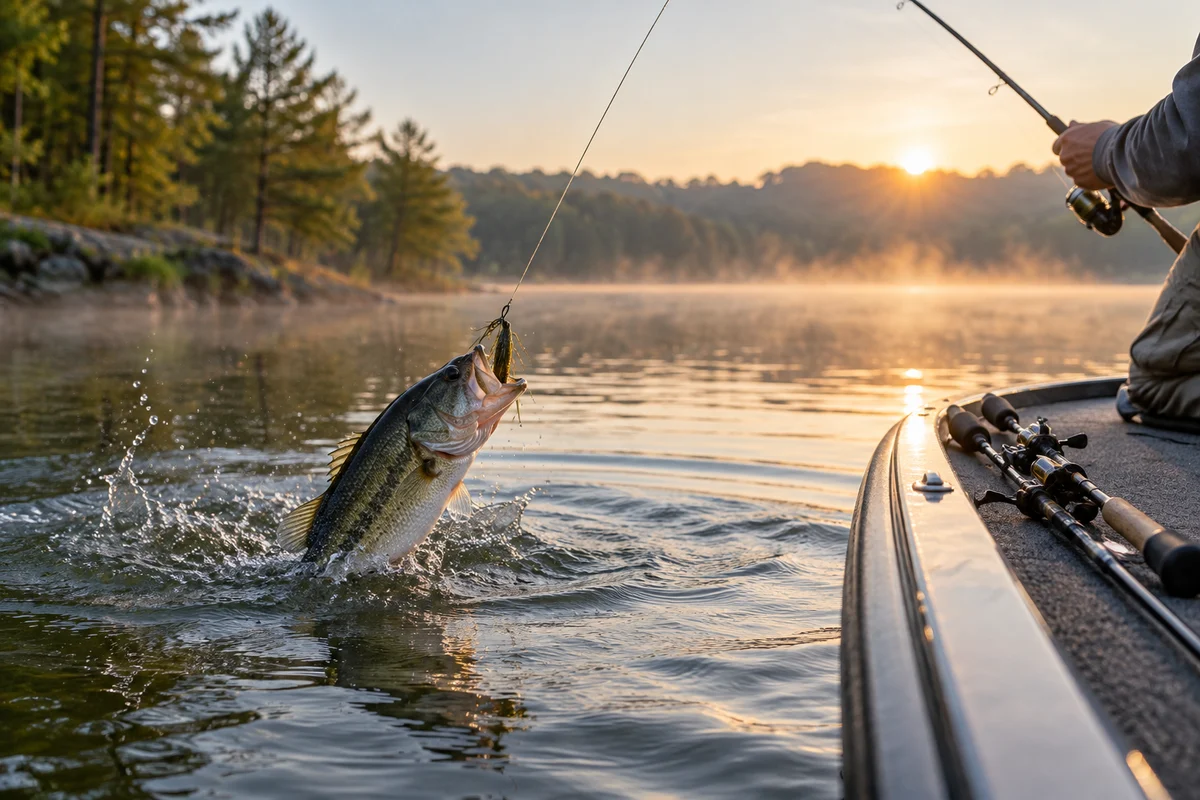
A clear lake bass record claim can sound definitive, but a place name and a large-fish story do not establish an official record. “Record” may refer to a verified state or world record, a local tournament result, or simply an angler’s report. Those are different kinds of claims. Understanding the distinction helps readers assess headlines and helps visiting anglers focus on sound fishing, accurate documentation, and care for the fishery.
What does “record” mean in a bass story?
Before repeating a record claim, identify the category. An official state record is administered under that state’s rules. A world-record claim may be reviewed by an organization such as the International Game Fish Association, whose eligibility requirements and documentation process are separate from a local event’s rules. Tournament results, meanwhile, apply to a particular competition and may use a total weight, a daily limit, or another format.
A fish described as a personal best or a lake “giant” is not automatically a record in any of those systems. It may be a perfectly genuine catch without having been weighed or documented under a record program. Likewise, a tournament-winning fish is not necessarily a state or world record. Use the narrowest accurate description supported by the available evidence.
What evidence makes a record claim credible?
Start with the source of the claim. Is there an official record listing or a statement from the organization responsible for reviewing it? Does the report name the exact category, species, location, and status—pending or confirmed? A headline alone, a social-media post, or a striking photograph cannot answer all of those questions.
For a record application, the governing organization sets the requirements. These can include how the fish is identified and weighed, who witnesses the process, what equipment or documentation is required, and how the catch’s circumstances are established. Requirements vary, so anglers should consult the relevant program rather than assume that one set of rules applies everywhere. The IGFA’s official site is a starting point for its own international record and rules information, not proof that any particular Clear Lake catch qualifies.
A photograph can provide context, but perspective and lens distance can make a fish look larger or smaller. A photo also does not establish a certified weight. Avoid converting an image, an unverified scale reading, or a secondhand account into a precise claim.
Which bass species and record category are involved?
“Bass” is a common name used for more than one species. A record search should identify the species listed by the record authority, not infer it from a generic caption. The category matters too: records may be separated by species, location, method, or other rules set by the organization. Do not compare a fish to a record until those labels match.
Weight and length are also different measurements. A fish described as exceptionally long is not necessarily the heaviest, and a length estimate does not establish a weight record. If the report supplies only one measure, keep the claim limited to that measure. If it supplies neither official documentation nor a clear source, describe it as an unverified report rather than a confirmed record.
How should anglers assess Clear Lake catch reports?
Treat the original account as a lead and look for confirmation from the appropriate record body or event organizer. Check whether the catch is described as pending review or officially accepted. If the report is from a tournament, consult that tournament’s published results and rules; do not silently recast its result as a lake or state record.
The phrase “during pre-fishing” also has a specific fishing context: anglers may scout and practice before a competition, subject to the event’s rules. It does not by itself verify an event, a catch, or a record. Since an old headline slug is not evidence that a particular fish was caught, weighed, or recognized, no record status should be inferred from that wording alone.
When writing or sharing a claim, preserve uncertainty. “An angler reported a large bass at Clear Lake” is more responsible than announcing a record without independent confirmation. If an official record listing cannot be found, say so plainly and avoid adding an estimated weight, date, angler identity, or tournament detail that has not been verified.
What makes a productive bass outing more useful than chasing a headline?
Plan around conditions rather than a promised result. Check current regulations, access information, and any local restrictions before traveling; rules and conditions can change. On the water, observe wind, water clarity, and temperature trends, then choose a presentation that suits the conditions and your tackle. For early-season options, compare approaches in our guides to spring bass with Wiggle Warts and early-season bass lipless crankbaits.
A reported giant should not dictate unsafe or careless handling. Use tackle appropriate to the fish and conditions, keep the fish in the water when practical, and minimize handling time if releasing it. Wet hands before touching a fish, support its body rather than holding it by the jaw alone when its size makes that appropriate, and follow local rules for harvest, seasons, and possession. If you intend to keep a fish, know the applicable regulations before you launch.
Good notes improve your own understanding without turning an estimate into a public record: record the date, general conditions, location at a level consistent with privacy and local rules, lure or technique, and measurements you actually took. For additional bass techniques and context, explore more freshwater bass coverage.
Common mistakes when discussing big-bass claims
The most frequent error is treating “largest reported,” “tournament winner,” and “official record” as interchangeable. Another is comparing fish from different species or record categories. A third is using a photo or an estimated measurement to supply a precise weight that the source never documented.
There is also a difference between not finding evidence and proving a report false. If a claim is not present in an authoritative record listing, the careful conclusion is that it remains unverified—not that it could not have happened. That distinction keeps coverage fair to anglers while protecting readers from invented certainty.
A practical standard for record coverage
A dependable report names the record authority or event, identifies the relevant category, distinguishes pending review from confirmation, and links to the responsible source when possible. If those details are missing, describe the story as a report and explain what remains unknown. This standard applies to Clear Lake and any other destination: celebrate the fishing, but let the evidence determine whether a record was actually set.
How can I check an official bass record?
Identify the correct record authority and category, then consult its current official listing or application guidance. A local tournament result and an angler’s report are not automatically state or world records.
Does a photograph prove a bass is a record?
No. A photograph may document the catch’s appearance, but it does not independently establish species, certified weight, eligibility, or acceptance by a record authority.
What should I do if a Clear Lake record claim is unconfirmed?
Call it an unverified report, avoid adding unsupported details, and check with the relevant record organization or event organizer for confirmation.
Frequently asked questions
How can I check an official bass record?
Identify the correct record authority and category, then consult its current official listing or application guidance. A local tournament result and an angler’s report are not automatically state or world records.
Does a photograph prove a bass is a record?
No. A photograph may document the catch’s appearance, but it does not independently establish species, certified weight, eligibility, or acceptance by a record authority.
What should I do if a Clear Lake record claim is unconfirmed?
Call it an unverified report, avoid adding unsupported details, and check with the relevant record organization or event organizer for confirmation.
Sources & further information
Consult these primary sources for current regulations, technical information and local guidance.