Vexilar Fish Scout Review: What It Can—and Can’t—Show
A practical, model-conscious guide to using the Vexilar Fish Scout underwater camera for ice fishing: what it helps you learn, what can limit the view, and when sonar is the better tool.
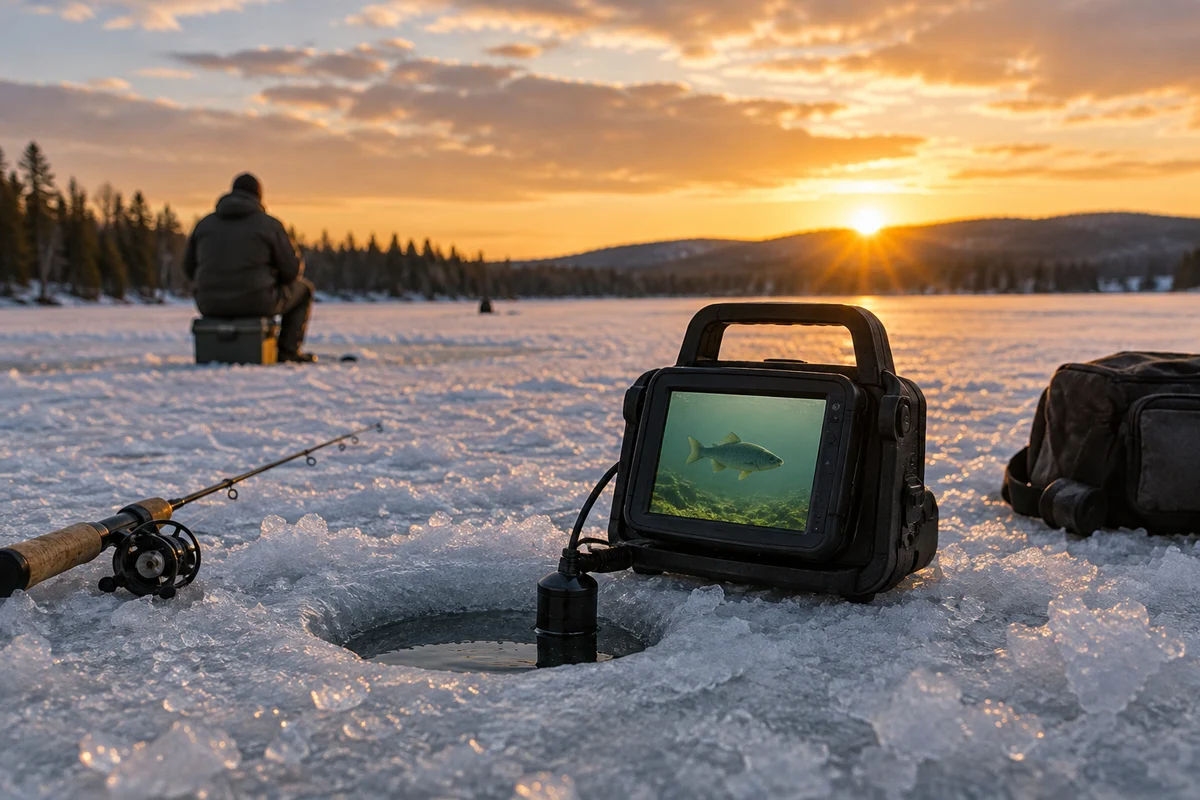
An honest Vexilar Fish Scout review starts with a distinction: an underwater camera shows you a picture, while a flasher or fishfinder summarizes returns as signals. Those views answer different questions. A camera may reveal weeds, bottom texture, a lure’s action, or a fish near the lens; it cannot guarantee that fish will appear in its narrow field of view or that the water will be clear enough to see them. Treat it as a way to inspect a small patch of the underwater world—not as a replacement for reading the whole water column.
Before heading out, verify the exact Fish Scout version, included components, and instructions from Vexilar or the product manual. Product details and availability can vary, and names alone are not a reliable guide to specifications. This article focuses on how to assess and use an underwater camera system safely and effectively, rather than assuming particular screen, cable, lighting, or recording features.
What can an underwater camera tell you?
The strongest use is visual confirmation in a spot where the water and conditions allow a useful image. You may be able to see whether a hole sits over vegetation, whether a lure is fouled, how a bait moves, or whether a fish approaches and turns away. That last observation can help you distinguish a presentation problem from a location problem—but only if a fish enters the camera’s view.
A sonar display answers broader, faster questions: is something suspended above bottom, how deep is the bottom, and where is your lure in the water column? The camera provides richer detail about what is directly in front of its lens, but it samples a much smaller area. Fish can remain outside the view, move away from the camera, or be obscured by cover. A blank screen does not prove that a hole is fishless.
That makes the Fish Scout most useful as a second opinion. Use sonar or your knowledge of the water to locate a promising depth or feature, then lower the camera to inspect the immediate scene when conditions are suitable. The ice-fishing hub has more planning and technique context in its ice-fishing guides.
When is a camera more useful than sonar?
Choose the tool according to the question rather than expecting either one to do everything.
| Field question | Camera is useful when… | Sonar is usually better when… |
|---|---|---|
| What is on the bottom? | The water is clear enough and the lens can be aimed at the area | You need a quick depth or bottom-return picture across changing locations |
| Is my lure working? | You can see the lure and its movement clearly | You want to track lure depth continuously while jigging |
| Are fish nearby? | A fish is close enough to enter the limited view | You want to monitor a larger slice of the water column |
| Should I move holes? | A clear visual check can resolve a specific nearby question | You are covering water and need quick comparisons between holes |
| Why are bites not happening? | You can observe a fish’s response to a visible presentation | You need to check depth, timing, or presence without waiting for a fish to pass the lens |
This is a decision aid, not a promise of what any particular device can display. Visibility, setup, water conditions, and model capabilities all matter. A camera can make an observation more concrete, but the angler still has to interpret it.
How do you get a useful view through an ice hole?
Start with the manufacturer’s instructions. Check the system before travel, protect cables and connectors from damage, and confirm that the display and camera operate as intended. Do not force a connector, improvise a repair, or assume a feature based on a product name. If something is damaged or behaves unexpectedly, follow the manual and ask the manufacturer for guidance.
At the hole, lower the camera gradually and keep the cable controlled so it does not snag on the auger opening, shelter hardware, or nearby gear. Begin with a simple orientation: identify the bottom or another fixed reference, then make small adjustments to aim. Rapidly swinging the camera can stir sediment or make the scene difficult to interpret. If the view clouds, pause and let disturbed material settle before deciding that the area itself is murky.
Test a short distance above bottom as well as near your lure. A lens pointed straight down may show substrate but miss a fish approaching from the side; a sideways view may catch movement but make depth harder to judge. Make one adjustment at a time and note what changed. If the image remains unhelpful, stop chasing a perfect picture and return to the question sonar can answer.
A visible lure can be informative, but do not infer a fish’s behavior from a single brief pass. A fish may be curious, feeding, startled, or merely crossing the frame. Look for repeated patterns and compare them with your own line, bait, and bite observations. When adjusting your presentation, simple alternatives such as changing jig cadence or bait size can be considered alongside options in this guide to jigs for ice fishing.
What conditions limit the image?
Clarity is not guaranteed. Suspended particles, algae, soft bottom, stirred sediment, low light, and the angle of the lens can all reduce detail. Vegetation can hide fish or block the scene. In a shallow, featureless area, a camera may add little; in a clear pocket near cover, a close view may be more revealing. Snow cover and changing light can also affect what is visible, depending on the camera system.
The field of view is another important limit. A camera observes a direction and area, not an entire lake or even the full space beneath an ice hole. A fish outside the frame is invisible to the lens. This is why camera and sonar results can appear to disagree without either being faulty: one may detect activity beyond the camera’s view, while the other shows only the scene directly ahead.
Cold-weather handling deserves attention too. Follow the product’s operating and storage guidance, keep electronics protected from moisture, and avoid leaving components exposed longer than necessary. Secure the cable and screen where they will not become a trip hazard or interfere with safe movement around the hole. Never let electronics distract from ice conditions, nearby anglers, or changing weather.
Is the Fish Scout worth carrying on an ice trip?
That depends on whether visual answers will change your decisions. If you often fish clear water, study lure behavior, or want to inspect a known feature, a camera can be a useful complement. If you move quickly, fish stained water, or mainly need depth and lure tracking, a sonar unit may be the more practical primary tool. Carrying both is useful only if the additional observation justifies the weight, setup, and attention.
Use this field decision framework:
- Ask one question. For example: is the lure visible, is the bottom weedy, or is a fish reacting nearby?
- Check whether a camera can answer it. Consider visibility, depth, cover, and the limited view.
- Set up deliberately. Follow the instructions, control the cable, and make small aiming changes.
- Compare observations. Use sonar, line behavior, and what happens at the hole rather than treating one screen as definitive.
- Move on when the view is not useful. A camera should inform a decision, not keep you stationary while conditions or fish activity call for a change.
Organization affects whether any electronics remain useful through a long day. Keep the camera system’s parts protected and accessible; this related guide to ice-fishing tackle storage covers practical ways to keep small gear from becoming a mess.
What should you check before buying or using one?
Because model configurations can change, compare the exact product listing and manual rather than relying on a generic description or an old announcement. Confirm what is included, how the system is powered and connected, the manufacturer’s operating limits, and whether its intended use fits your fishing conditions. If a specification is not clearly documented, contact Vexilar instead of inferring it.
Also consider the practical question: will you use a camera often enough to learn its controls and interpret its limitations? A camera is not a fish detector in the same sense as sonar, and no particular view ensures a catch. Its value is the visual context it can add when conditions cooperate. Used alongside careful location choices and a willingness to move, the Fish Scout concept can help make observations more direct without turning a screen into a guarantee.
Frequently asked questions
Does the Vexilar Fish Scout replace an ice-fishing flasher?
No. A camera shows a limited visual scene near its lens, while sonar is generally better for quickly tracking depth, lure position, and activity across more of the water column. They can complement each other.
Why might an underwater camera show no fish when sonar shows activity?
The fish may be outside the camera’s narrow field of view, obscured by cover or suspended particles, or moving through a different part of the water column. A camera view is not a lake-wide survey.
What should I verify about a Fish Scout before using it?
Check the exact model’s manual for included components, operating and storage guidance, connection details, and limits. Configurations and availability can vary, so consult Vexilar rather than guessing from the product name.
Sources & further information
Consult these primary sources for current regulations, technical information and local guidance.