Arkansas Snakehead Fish: What Anglers Should Know
Snakeheads are air-breathing fish that can raise questions when encountered in Arkansas waters. Here is how to think about identification, ecology, reporting, and responsible fishing without overstating what is known.
The phrase Arkansas snakehead fish can bring up urgent-sounding claims about an invasion, but a useful response starts with careful identification and current local guidance. Snakeheads are nonnative fish in North America, yet a report, photo, or old headline alone does not establish where a population exists today. Anglers can help by documenting what they see, avoiding unnecessary transport, and checking with wildlife officials before taking action.
What is a snakehead?
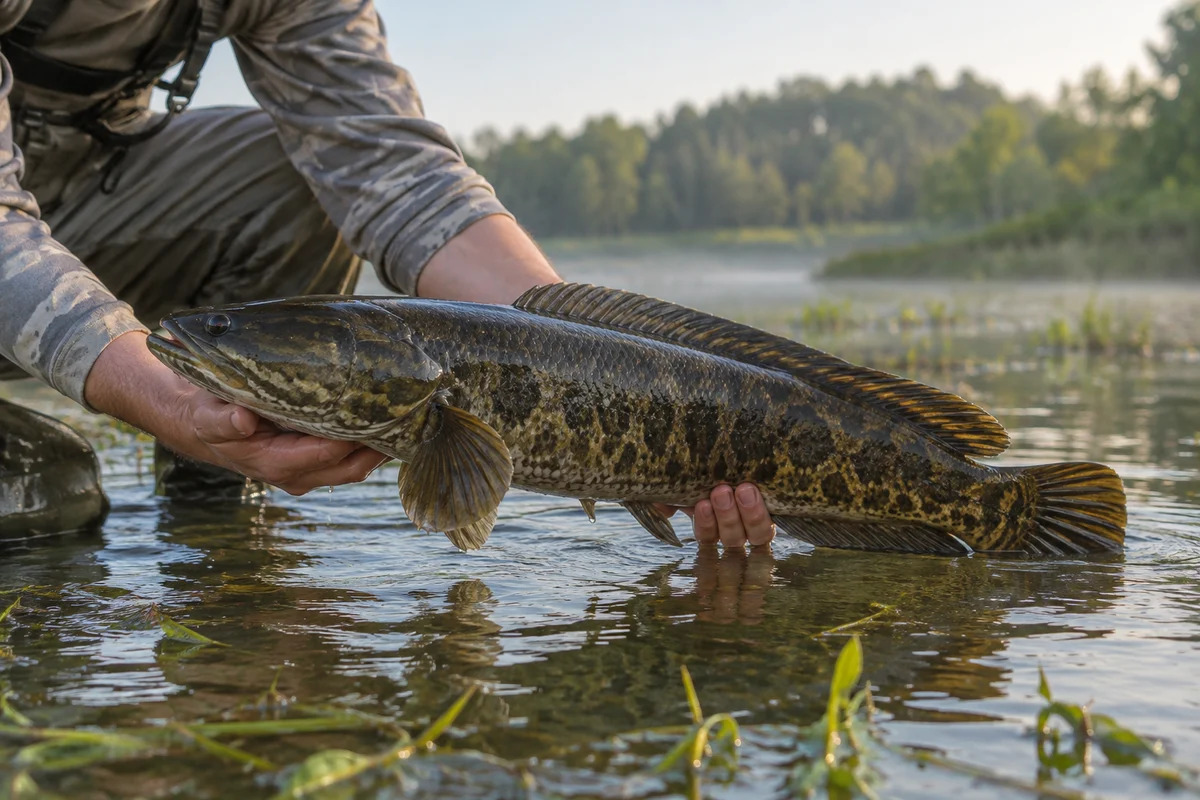
Snakeheads are freshwater fishes in the family Channidae, native to parts of Asia and Africa. They are named for their broad, flattened heads and scales that can give the head a somewhat snake-like appearance. Several species have been introduced outside their native ranges, and some have established populations in the United States.
A snakehead is not simply any long, mottled fish. Bowfin and native gar can be mistaken for one in a quick glimpse, especially in murky water or a phone photograph. Bowfin have a distinctive long dorsal fin and a rounded tail; gar have narrow, elongated jaws. A clear image of the entire fish, including head, fins, and tail, is much more useful than a close crop.
Identification matters because response rules depend on the species and location. Do not assume that a fish is a snakehead based on color alone, and do not handle a fish in a way that risks injury just to get a picture. If safe, photograph it in place and note the waterbody and approximate location.
What is known about snakeheads in Arkansas?
The key distinction is between a confirmed, established population and a possible sighting. A headline using words such as “fight” or “spread” may refer to an earlier concern; it is not a current distribution map. Reports can be misidentifications, isolated releases, or verified detections, and those categories should not be treated as interchangeable.
For current Arkansas-specific information, consult the Arkansas Game and Fish Commission and follow any notices or regulations it publishes. This article does not claim a present-day population, record, or statewide status. The commission is the appropriate authority for confirmation, reporting instructions, and any rules that apply to a particular waterbody.
If you are planning a trip, look up the latest regulations before fishing. Rules can change, and requirements may differ by species, water, or circumstance. A general article or an older social-media post cannot substitute for an official regulation.
Why can nonnative snakeheads concern fisheries?
An introduced fish may compete with native species for food or habitat, prey on other animals, and alter interactions in a food web. The actual effects depend on the species, abundance, habitat, and local community. It is not responsible to claim that every sighting has caused ecological damage or that one fish predicts an established population.
Snakeheads can breathe air using a specialized organ, allowing them to tolerate conditions that would challenge some other fish. This trait contributes to public interest, but it does not mean they can live anywhere or travel freely over land. Stories about fish moving across dry ground are often exaggerated; environmental conditions and species biology matter.
Fisheries management depends on evidence: reliable identification, location records, repeated sampling, and knowledge of habitat. Anglers can contribute useful observations without amplifying dramatic claims. When describing a report, distinguish what was observed from what is inferred.
What should an angler do after a possible sighting?
First, prioritize personal safety and comply with local rules. If the fish is landed during ordinary fishing, avoid releasing or transporting it until you have checked the current direction from the relevant wildlife agency. Do not move a live fish to another pond, river, or aquarium. Moving live aquatic organisms can spread nonnative species and may violate regulations.
Record the date, waterbody, general location, and conditions. Take several clear photographs if this can be done safely: one side view of the whole fish, a view of the head, and details of the fins and tail. Keep the fish in water when practical while seeking identification guidance, and do not handle it more than necessary. Contact the state wildlife agency through its current reporting channel rather than relying on a public comment thread.
Avoid publishing precise access details if they could encourage unauthorized collection or movement. A responsible report should be factual, calm, and clear about uncertainty. For broader federal invasive-species information, the U.S. Fish and Wildlife Service provides background on nonnative species and related management work; state officials remain the source for Arkansas rules.
Can anglers target snakeheads responsibly?
Where legal and supported by local guidance, fishing can be one part of management, but it should not be treated as a substitute for agency-led monitoring. Before targeting a suspected fish, verify the species and the applicable rules. Check restrictions on possession, release, transport, bait, and equipment, and avoid assuming that a rule from another state applies in Arkansas.
Use tackle appropriate to the water and fish, and handle any catch with wet hands or suitable tools to reduce injury. Keep native fish identification in mind: a mistaken decision can harm a native species. If identification remains uncertain, seek help from a wildlife professional rather than making a confident public claim.
Also take care not to transfer water, plants, or bait between waters. Clean, drain, and dry boats and gear according to local aquatic-invasive-species guidance. Small habits can reduce the chance of spreading organisms, even when the specific fish report turns out to be a misidentification.
Common mistakes that make reports less useful
One mistake is treating a dramatic photograph as proof of a new population. Images may be old, mislabeled, or taken elsewhere. Another is assuming every elongated fish is a snakehead. A third is making a release or transport decision based on hearsay rather than current regulations.
Avoid handling fish with dry hands, leaving them exposed while taking repeated photos, or moving them to a different site for a better picture. Do not release live bait or aquarium fish into public waters. And do not claim a specific ecological impact or distribution unless a reliable agency source supports it.
For context on fish identification and fishing stories beyond this issue, explore more outdoor coverage. Readers interested in how reported fish records require careful verification can also read about the biggest black buffalo carp record. For another perspective on anglers and their approach to the sport, see Joe Holland fishing.
A measured response helps protect Arkansas waters
The best response to the Arkansas snakehead fish question is neither panic nor dismissal. Learn the distinguishing features, check official sources for current status, report plausible observations with useful documentation, and never move live fish between waters. Those steps help wildlife managers separate rumor from evidence and protect native fisheries while keeping anglers informed.
FAQ
Are snakeheads confirmed in every part of Arkansas?
This article does not establish a current statewide distribution. Check the Arkansas Game and Fish Commission for verified reports and current local guidance; a sighting or old headline is not proof of a population.
What should I do if I think I caught one?
Photograph the fish safely, note where it was caught, and contact the state wildlife agency for identification and instructions. Check current rules before releasing, keeping, or transporting it, and do not move live fish to another waterbody.
Can a photograph confirm a snakehead?
A clear photograph can help, but identification may require views of the whole fish and its fins, head, and tail. Similar-looking native fish can be confused with snakeheads, so seek expert confirmation when uncertain.
Frequently asked questions
Are snakeheads confirmed in every part of Arkansas?
This article does not establish a current statewide distribution. Check the Arkansas Game and Fish Commission for verified reports and current local guidance; a sighting or old headline is not proof of a population.
What should I do if I think I caught one?
Photograph the fish safely, note where it was caught, and contact the state wildlife agency for identification and instructions. Check current rules before releasing, keeping, or transporting it, and do not move live fish to another waterbody.
Can a photograph confirm a snakehead?
A clear photograph can help, but identification may require views of the whole fish and its fins, head, and tail. Similar-looking native fish can be confused with snakeheads, so seek expert confirmation when uncertain.
Sources & further information
Consult these primary sources for current regulations, technical information and local guidance.