Muskie Underwater Video Footage: What It Can Teach Anglers
Clear underwater footage can make a muskie’s movements easier to interpret, but a clip is only a glimpse of one fish in one setting. Use it to notice posture, cover, and reactions without mistaking edited video for a complete fishing lesson.
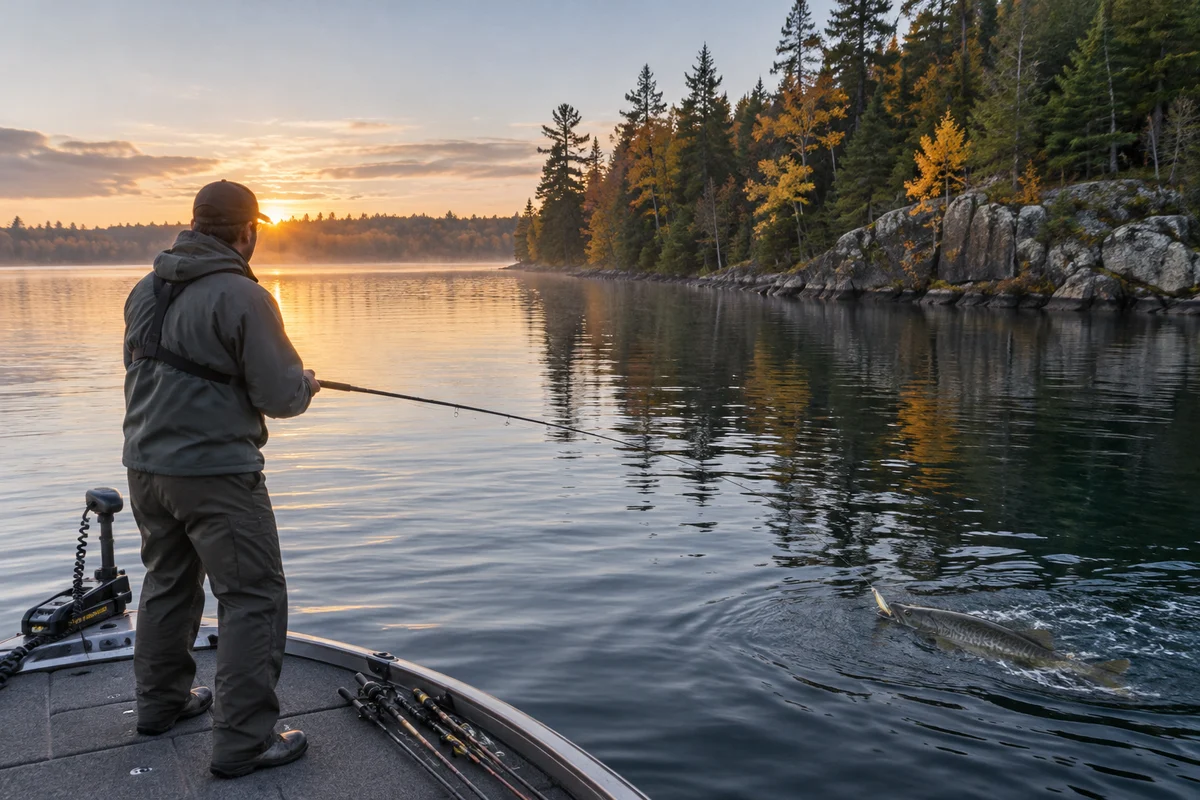
Clear muskie underwater video footage can make a powerful fish seem close enough to study: a long silhouette glides past vegetation, turns toward a moving lure, or disappears into darker water. The most useful lesson is not a guaranteed lure choice or a secret pattern. It is how to look carefully at the fish’s position, movement, and surroundings—and remember that a short recording shows only a small slice of a much larger environment.
If you watch a clip to prepare for a day on the water, begin with observation rather than imitation. Ask where the fish is in relation to cover, whether it is cruising or holding, and what changes when something enters its view. Then compare those clues with local conditions and rules. For broader context, the muskie fishing video hub collects related material, while articles on how to fish for pike and muskie fishing in Indiana offer useful neighboring perspectives.
What can clear underwater footage actually show?
A good clip may reveal a fish’s body orientation, pace, and relationship to visible structure. You might see a muskie travel along a weed edge, pause near a shadow, or turn as a lure passes. These are observable moments. They can prompt thoughtful questions about habitat and presentation, but they do not establish a universal rule about what muskies prefer.
The camera also changes what you see. A fish may be near the lens or far beyond it; perspective can make size and speed hard to judge. Water clarity, light, camera movement, and frame rate affect apparent color and motion. A fish that seems to accelerate could be moving steadily while the camera pans. A sudden turn may be a response to the lure—or simply a change in direction that coincides with it.
Treat footage as a field observation, not a controlled experiment. Unless the recording establishes the setting and conditions, viewers usually cannot know the depth, temperature, season, current, fish’s prior activity, or whether the fish has encountered the lure before.
How to read a clip without overreading it
Watch once for the broad scene, then replay specific moments. Keep notes about what is visible and separate that from what you infer. A practical viewing framework is below.
| What to notice | What you can reasonably say | What remains uncertain |
|---|---|---|
| Fish position | It is near a weed edge, open water, or a visible obstruction | Whether that location is typical for the lake or season |
| Body posture | It is oriented forward, turning, or holding relatively still | Its motivation or level of feeding activity |
| Movement | It glides, changes direction, or follows an object briefly | Exact speed, distance, or cause of the movement |
| Lure interaction | The fish approaches, follows, ignores, or turns away | Whether the lure, camera, or another factor caused the response |
| Habitat in frame | Plants, bottom, or light and shade are visible | What lies outside the camera’s limited view |
A follow is especially easy to misinterpret. A fish moving behind a lure is not necessarily committed to striking, and an apparent rejection does not prove that the lure, color, or retrieve is wrong everywhere. Video rarely captures all relevant sensory cues or the fish’s history. Describe the sequence plainly: “the fish followed for a short distance and turned away,” rather than “this retrieve triggers muskies.”
What details matter most for fishing decisions?
Start with habitat. Note whether the fish uses a transition between vegetation and open water, stays close to a shaded edge, or crosses a more exposed area. Those details can suggest where an angler might pay attention, but local knowledge and seasonal conditions still matter. Underwater scenes are often recorded in unusually clear water or at a particular site; they should not be treated as a map of every muskie lake.
Next, look at the fish’s orientation and the lure’s path. Does the object pass ahead of the fish, move across its view, or travel away from it? These observations help explain the visible interaction without claiming to know what the fish perceived. If the camera angle hides the fish’s eyes or the lure’s distance, mark the interpretation as uncertain.
Finally, consider what the clip leaves out. There may be multiple takes, cuts, or an unshown lead-in. A dramatic moment can be genuine while still being unrepresentative. Edited footage is made to communicate a scene, not necessarily to document every cast or all the conditions around the encounter.
Can video tell you which lure or retrieve to use?
Not by itself. Footage can show that a fish approached a particular moving object in that moment. It cannot establish that the same lure or action will work in another waterbody, at another time, or for another fish. Nor can one non-response demonstrate that a presentation is ineffective.
Use a clip to generate a testable question for your own fishing: Are fish holding tight to cover today? Are they following but turning away? Does changing angle or pace produce a different response? Keep changes deliberate rather than switching everything at once. Record the date, general conditions, location type, and what happened. Over time, your own observations can become more relevant than a single memorable video.
For species comparisons, remember that “muskie” commonly refers to muskellunge, while tiger muskellunge are hybrids. A video’s title or casual narration may not document identification carefully. If distinguishing fish matters, seek reliable regional identification information and avoid treating a label attached to an online clip as proof. For regional fishing context, see Indiana muskie fishing; for a related northern predator, the guide to pike fishing basics provides a useful comparison without implying identical behavior.
A simple field checklist for anglers
Before applying a clip to your own fishing, ask:
- What is directly visible? Describe position, movement, cover, and any interaction without assigning motive.
- What is missing? Consider season, depth, water temperature, camera distance, edits, and location.
- Is the species identification dependable? Look for clear context rather than relying only on a title.
- Does the situation resemble your water? Similar cover and conditions make an observation more relevant, but not conclusive.
- What one variable will you observe next? Change or record one factor at a time where practical.
- Are you following local rules? Check current regulations for the water you plan to fish, including any special harvest, equipment, or access rules.
The last point matters because regulations vary by jurisdiction and can change. The U.S. Fish and Wildlife Service provides federal fish and wildlife information, while state wildlife agencies publish the rules that apply to particular waters. Confirm current local requirements before fishing, and handle any fish carefully in accordance with applicable guidance.
Why responsible viewing matters
Underwater recordings can educate, but they can also encourage viewers to assume a fish is always available for a close encounter. It is better to treat wildlife as unpredictable and avoid disturbing fish or habitat for the sake of a shot. If you record your own fishing, prioritize safe boating, legal access, and respectful handling. Do not let a camera or a dramatic clip replace attention to conditions around you.
Clear footage is most valuable when it sharpens observation rather than promising certainty. Notice the fish’s path, its relationship to cover, and the limits of the camera. Then use those observations as one small input alongside local knowledge, regulations, and your own careful notes. A short clip cannot reveal everything about a muskie—but it can teach you to look more closely.
Frequently asked questions
Can muskie underwater footage show why a fish follows a lure?
It can show the sequence of movements, but rarely establishes the fish’s motivation. The camera may not reveal all relevant cues, and a follow can have several explanations.
Can one video tell me the best muskie lure or retrieve?
No. A clip documents one encounter under particular conditions. Use it to form a question, then observe how fish respond in the water you are fishing.
How can I tell a muskie from a tiger muskellunge in a video?
A clip may not show enough detail for confident identification, and online titles are not proof. Use dependable regional identification guidance when the distinction matters.
Sources & further information
Consult these primary sources for current regulations, technical information and local guidance.