Sturgeon Chesapeake Bay: What Surveys Can—and Can’t—Tell Us
A survey that finds no sturgeon is not proof that none are present. Understand how sampling limits, fish behavior and habitat influence what researchers can conclude in Chesapeake Bay.
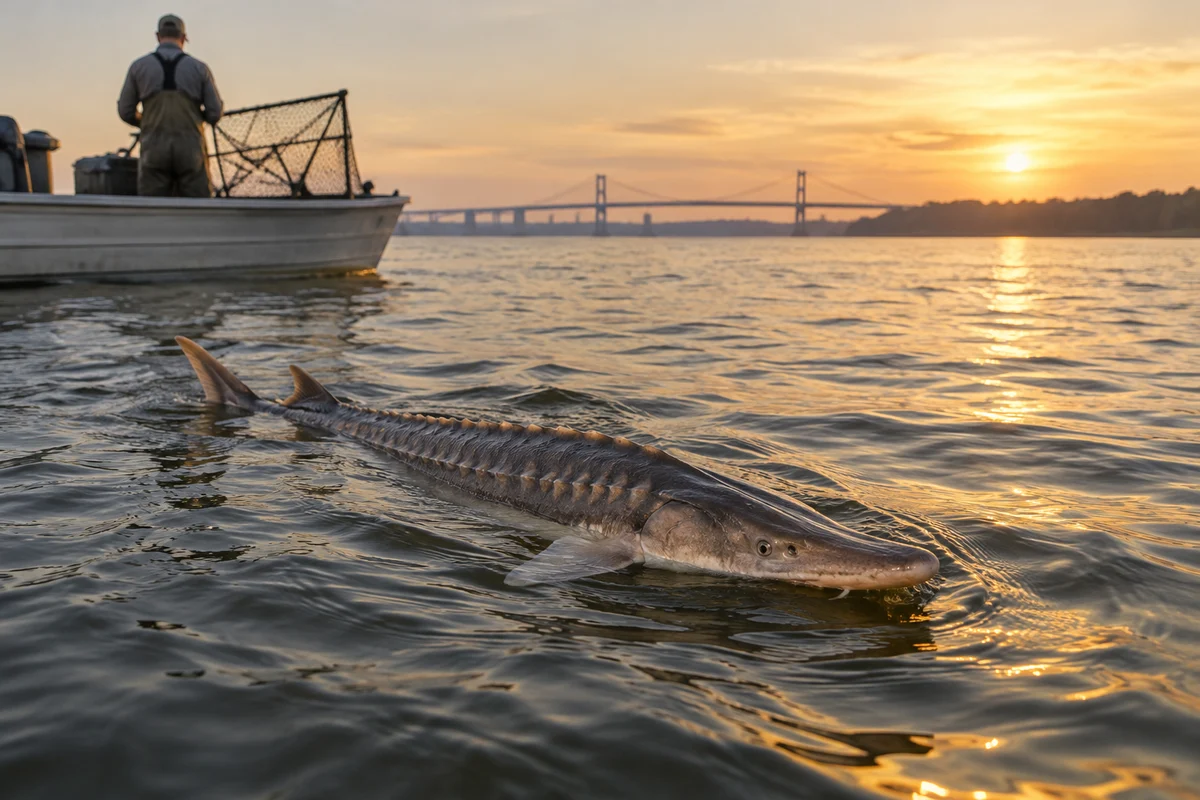
A sturgeon Chesapeake Bay survey can help researchers understand where these large, long-lived fish occur, but a survey that reports no detections does not establish that the bay is empty of sturgeon. The result means that the particular methods and effort did not record fish during the surveyed places and times. For anglers and curious readers, that distinction is essential: interpreting a survey requires looking beyond a headline to the sampling design, habitat and limits of detection.
Atlantic sturgeon are anadromous fish: they use marine and estuarine waters and migrate into rivers to spawn. Their movements, low population abundance in some areas, and use of different habitats across life stages make them difficult to count. A careful reading separates what a survey actually observed from broader claims about the species.
What does a negative survey result mean?
In plain language, “negative” usually means the survey did not detect the target fish under its stated conditions. It is an observation, not a census of every channel, tributary and season. Researchers may use nets, acoustic instruments, tagging, environmental sampling or combinations of methods. Each approach detects only certain fish, places or behaviors, and each has its own limitations.
A non-detection can occur when fish are absent from a sampled location, but it can also happen when fish are present outside the sampling area, pass through at another time, or are not detected by the method. Turbidity, water depth, current, substrate, equipment settings and survey duration can all affect what is measurable. The report’s methods and caveats are therefore part of the finding, not fine print to skip.
The key questions are practical: What area was covered? How many visits were made? What season and conditions applied? Which life stages could the method detect? Were the results compared with prior surveys using comparable techniques? Without those details, a short description of a “negative survey” cannot support a confident claim about the baywide population.
Why are Atlantic sturgeon hard to survey?
Sturgeon do not behave like stationary targets. They move between rivers, estuaries and coastal waters, and their routes and timing can vary. Adults may be associated with spawning migrations, while younger fish use different areas. A survey focused on one reach or brief window may miss fish that use the broader system at other times.
Their low density can also make encounters uncommon even when fish remain in a region. This is a familiar challenge in wildlife monitoring: the chance of detection depends both on whether an animal is present and on whether the survey can find it. Repeated observations and multiple methods can improve understanding, but they do not turn a limited sample into a complete inventory.
For readers following saltwater science, this is why a survey result should be read alongside species biology and study design. Other marine-fishing topics, such as understanding an Atlantic bluefin tuna stock assessment, also show why population assessments depend on evidence collected across places, years and methods.
What habitat and timing should readers look for?
Atlantic sturgeon use a connected range of habitats. River channels and spawning areas matter to reproduction; estuaries provide migration and feeding corridors; coastal waters connect populations to a wider seascape. A report should identify which portion of that life cycle its sampling was designed to address. A finding in one location cannot automatically describe every habitat used by the species.
Timing matters just as much. Migration and spawning are seasonal, while fish movement can respond to environmental conditions. A survey outside a key movement period may answer a useful question about that period without answering whether fish use the same waters at another time. When comparing results, check whether surveys covered similar seasons and locations before treating a difference as a population trend.
Habitat quality is another part of the conservation picture. Barriers, altered river conditions, dredging and other human pressures can affect access or habitat, but a single non-detection does not identify a cause. Establishing causes takes targeted evidence and long-term monitoring. The U.S. Fish and Wildlife Service provides general information on Atlantic sturgeon conservation and species status through its species and conservation resources.
How should a survey be evaluated?
Start with the report itself, rather than a headline or a social post. Look for the study area, dates, sampling gear or technique, number of survey events, and the way researchers define a detection. Then check whether the report explains uncertainty, including conditions that could reduce detection probability.
Next, distinguish the observation from the interpretation. “No fish were detected in the sampled locations during this effort” is narrower than “sturgeon are absent from the Chesapeake.” The first may accurately summarize a survey; the second requires much broader evidence. Similarly, one year’s result should not be described as a population collapse or recovery without a valid comparison and supporting data.
Finally, look for independent context: agency monitoring, peer-reviewed studies, and information on connected rivers or coastal waters. A fishing story about another species can illustrate how much context matters; for example, claims about a world-record black drum raise separate questions about species identification, documentation and record eligibility. Those are not evidence about sturgeon, but they reinforce a useful habit: verify the specific claim with the appropriate source.
What does this mean for anglers and boaters?
A survey non-detection is not permission to handle or target a protected fish. Regulations and protections can apply even when a survey has not found fish in a particular place. Anglers should identify fish carefully, avoid unnecessary handling, and consult current state and federal rules before fishing. If a sturgeon is encountered, follow applicable reporting and release guidance from the responsible wildlife agency; do not rely on an old article or an informal identification alone.
Boaters can help by respecting marked research activity, avoiding interference with scientific gear, and following local navigation notices. If you see a fish that may be a sturgeon, note the location and conditions from a safe distance and use official agency reporting channels where available. Do not pursue or capture an animal to confirm an identification.
The broader lesson is that absence of evidence in one survey is not evidence of total absence. It is a reason to ask what was sampled and what the next monitoring step should be. For context on related marine subjects, browse more outdoor coverage, including stories on coastal fisheries and the methods used to interpret them.
Why does long-term monitoring matter?
Long-lived species can take years to mature, so short snapshots may not reveal the full effects of changing conditions or conservation measures. Consistent monitoring helps researchers compare like with like, recognize patterns and identify gaps in knowledge. Surveys also become more useful when their methods are documented well enough that later teams can interpret differences fairly.
No single negative result settles the status of Atlantic sturgeon in Chesapeake Bay. It contributes one piece of evidence, with a defined geographic and methodological scope. The sound conclusion is neither that the fish are certainly absent nor that a survey is meaningless: it is that the result should be interpreted at the scale it actually measured, then considered alongside other reliable evidence.
FAQ
Does a negative sturgeon survey prove there are no fish in Chesapeake Bay?
No. It means the survey did not detect sturgeon in its sampled area and conditions. Fish may be elsewhere, present at another time, or undetected by the method used.
Why might a survey miss sturgeon that are present?
Fish move through a large, connected habitat, and detection depends on timing, location, method and environmental conditions. Limited sampling effort can miss animals even when they occur in the broader region.
What should an angler do if they encounter a possible sturgeon?
Avoid targeting or handling it, follow current state and federal rules, and use official wildlife-agency guidance for identification and reporting. Never assume a survey result changes legal protections.
Frequently asked questions
Does a negative sturgeon survey prove there are no fish in Chesapeake Bay?
No. It means the survey did not detect sturgeon in its sampled area and conditions. Fish may be elsewhere, present at another time, or undetected by the method used.
Why might a survey miss sturgeon that are present?
Fish move through a large, connected habitat, and detection depends on timing, location, method and environmental conditions. Limited sampling effort can miss animals even when they occur in the broader region.
What should an angler do if they encounter a possible sturgeon?
Avoid targeting or handling it, follow current state and federal rules, and use official wildlife-agency guidance for identification and reporting. Never assume a survey result changes legal protections.
Sources & further information
Consult these primary sources for current regulations, technical information and local guidance.