Interesting Facts About Harpy Eagle: A Forest Raptor
A field-minded guide to the harpy eagle’s life in tropical forests, from its specialized hunting to the habitat pressures that shape its future.
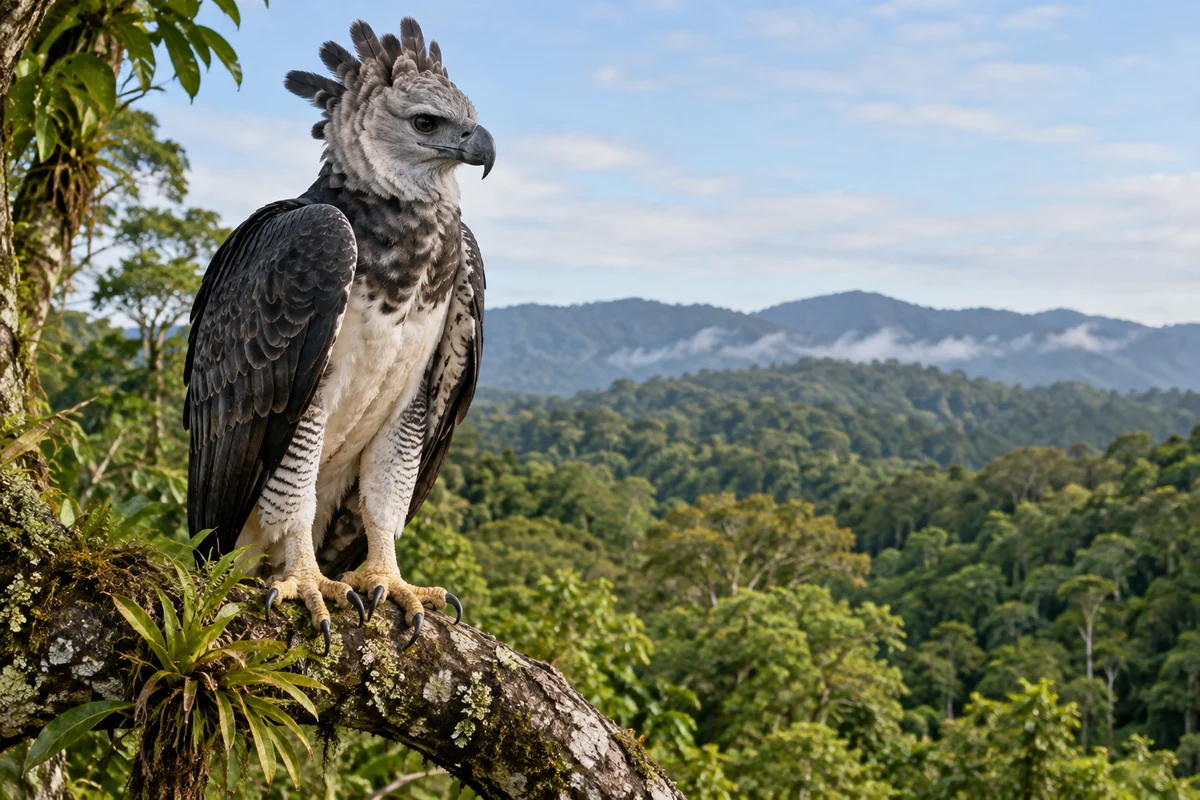
The interesting facts about harpy eagle that matter most are rooted in its role as a forest predator: this large, crested raptor lives in parts of Central and South America, hunts among trees, and depends on extensive, connected habitat. Its dramatic appearance attracts attention, but understanding its ecology means looking beyond size to its slow life cycle, specialized prey, and vulnerability to forest loss.
Harpy eagles are not animals most people will encounter in the wild. They spend much of their lives in forest canopies and are naturally uncommon across broad areas. Here are practical ways to understand the species and the conservation questions surrounding it without confusing striking anecdotes with established evidence.
Where do harpy eagles live?
Harpy eagles inhabit tropical forests in Central and South America. Their range is associated with large forest landscapes, especially humid lowland forests, though local habitat and occurrence vary. A map showing a broad regional range does not mean the birds are evenly distributed or easy to find: suitable forest can be separated by cleared land, roads, farms, and settlements.
The canopy is both hunting ground and shelter. Large trees offer places to perch, scan for prey, and build a nest. A forest patch may look green from above yet still be too small or isolated to support the space and resources a breeding pair needs. For that reason, habitat conservation is about more than keeping a few impressive trees standing; it also involves maintaining connected forest and limiting disturbance around important nesting areas.
For a broader look at wildlife and habitat issues, explore more outdoor coverage. Conservation stories are strongest when they connect individual species to the landscapes and ecological relationships that sustain them.
What makes its appearance distinctive?
A harpy eagle is recognizable by its broad wings, powerful build, pale underside, dark upperparts, and feather crest. The crest can rise when the bird is alert, creating a distinctive silhouette. Its legs and feet are adapted for gripping prey, while its wings help it maneuver through a forest environment rather than simply soar over open country.
Descriptions often emphasize the bird’s talons or compare its size with familiar objects. Those comparisons can be vivid, but they are not a substitute for measured field data, and measurements vary by sex, age, and source. The female is generally larger than the male, a pattern found in many raptors. The practical ecological point is that the pair’s different sizes can support complementary hunting roles, though individual behavior and local conditions vary.
A crest, dramatic profile, or photograph alone cannot establish whether a bird is nesting, feeding, or defending a territory. Observers should keep their distance, avoid disturbing a nest, and follow local wildlife guidance rather than approaching for a closer view.
What does a harpy eagle eat?
Harpy eagles prey on animals that live in trees, including sloths and monkeys, along with other suitable mammals and birds. The precise menu depends on what is available in a particular forest. This arboreal hunting niche sets the eagle apart from raptors that specialize in catching fish or pursuing prey across open ground.
A powerful grip helps the bird capture and carry prey through a cluttered canopy. But a predator’s presence does not mean every potential prey animal is equally vulnerable, nor does one observation describe the diet of an entire population. Ecologists learn about diet through repeated evidence, such as observations at nests and other carefully documented records.
Predators can influence food webs, but it is usually too simple to say that one species single-handedly keeps an ecosystem balanced. The eagle’s well-being reflects a network of conditions: enough forest, prey populations that can persist, nesting sites, and limited disturbance. Protecting the predator therefore also means paying attention to the wider forest community.
How does nesting shape its life cycle?
Harpy eagles build large nests high in trees, often using substantial branches as a platform. A nest can be reused or maintained over time, making the tree and surrounding area important well beyond a single breeding attempt. Nest locations are difficult to survey, and reported breeding details can differ between populations and studies.
Like many large raptors, harpy eagles reproduce slowly compared with small, short-lived birds. A pair invests considerable care in raising young, and successful breeding is not guaranteed every year. This slow pace matters for conservation: when adults or nesting habitat are lost, a population may not recover quickly. Protecting active nest sites from disturbance can be as important as protecting feeding habitat.
People who live or work near forest areas can help by reporting credible sightings to local wildlife authorities or conservation researchers, while avoiding nest approaches and sharing sensitive location details cautiously. A public post that pinpoints a nest may bring unwanted visitors to a vulnerable site.
What threatens harpy eagles?
Forest clearing and fragmentation are central concerns. Conversion of forest for agriculture, roads, development, or other uses can remove nesting trees and divide habitat into smaller pieces. Hunting and persecution may also affect wildlife in some places. The scale and importance of each pressure vary geographically, so a single global explanation should not be treated as a precise account of every local population.
Large, slow-breeding birds are especially exposed to repeated losses. A cleared patch may eliminate a nest tree immediately, while fragmentation can make it harder for birds to find prey or maintain territories over time. Conservation planning therefore benefits from protecting broad landscapes, supporting forest connectivity, and working with local communities whose livelihoods and land stewardship shape the outcome.
Species stories are part of a wider conservation picture. For comparison, read about the eastern hellbender and its Pennsylvania state amphibian designation and the headwater chub conservation listing. These examples involve different habitats and policy questions, but each shows why clear evidence and species-specific context matter.
How can readers separate facts from dramatic claims?
Start by asking what kind of claim is being made. A verified field observation is not the same as a range-wide estimate; a record from one nest is not a universal behavior; and a striking photograph cannot establish population trends. Look for a source that identifies its methods, location, and date, and distinguish an agency assessment from an anecdote or a social-media caption.
The U.S. Fish and Wildlife Service provides information on wildlife and conservation programs, while the International Union for Conservation of Nature maintains species assessments and conservation resources. For a specific local question, national or regional wildlife agencies and established conservation researchers may have the most relevant information. Assessments can be updated, so consult current sources before repeating a status label as definitive.
Readers can support sound conservation by sharing location details responsibly, avoiding disturbance, and favoring habitat-focused work with transparent methods. The most useful story about the harpy eagle is not simply that it is formidable. It is that a forest specialist depends on a living, connected landscape—and that protecting such landscapes helps many species at once.
Frequently asked questions
Is the harpy eagle found throughout the Americas?
No. It is a tropical American species associated with parts of Central and South America. Its broad geographic range does not mean it occurs everywhere within that region; habitat condition and local distribution matter.
Does the harpy eagle mainly eat fish?
No. It is a forest hunter whose prey includes arboreal animals such as sloths and monkeys, as well as other locally available prey. Its diet varies with place and opportunity.
Why is forest connectivity important to harpy eagles?
Connected forest helps preserve nesting trees, hunting habitat, and the ecological relationships a breeding pair needs. Fragmentation can isolate habitat and increase pressure on a species that reproduces slowly.
Sources & further information
Consult these primary sources for current regulations, technical information and local guidance.